The first thing that comes to mind when I think of gender in the military is the "Don't Ask, Don't Tell" policy. This simply means that you shouldn't ask anyone about their sexuality, and you shouldn't be talking about your own. In retrospect, the idea of not discussing sexuality should be connected to the fact that something as trivial as this should have nothing to do with the way people preform their duties. If all people are trained the same, and tested the same, and can preform at a level that is consistent with all the others in the military, then there should be no reason to reject or dismiss people. This same idea goes along with women in the military. We see far less women in the military because this is not where the gender stereotypes want them to be. They want them to be at home with the family, being a military wife. When a father is at home, being a military husband, gender stereotypes come into play again. This role reversal is not so common, as well as judged based on the gender stereotypes. Is a man going to have a harder time at home with his children when is wife is away? The immediate answer to this question should be no. Stereotyping men as military fathers compared to military wives is not fair. It goes hand-in-hand with the ideas of single parenthood. This is less of a role reversal and more of a surviving based on the situation you are in. Which should go for all military families. Media plays into these stereotypes all too often. There are always commercials on TV and the internet about a military wife and her children waiting and worrying about when her husband will come home. BUT, there are commercials in the media that portray female soldiers returning home. Here is one example that comes to mind. In this commercial, a woman is coming home to a dog, rather than a family. This can be taken a few different ways. One way beings, hey look they are finally showing women from the military returning home, or two, why not show her returning to a family. Does she not have a family yet? Etc. I also understand this is a commercial for dog food, but it still raises important questions. There is so much debate and discussion revolving around gender in the military. I think it is important to allow people to be who they are, as well as work together to fight for our country. There should be no reason why people who are different should be penalized for trying to defend our country.
Sunday, March 29, 2015
Friday, March 27, 2015
Sound & Fury - Fred Phelps and Life inside Westboro March 27th 2015
Pictured above Westboro Baptist Church, founded in 1955 by Fred Phelps. This church has no affiliations with other Baptist churches or Calvinist conventions. Phelps founded this church express his radical opinions on controversial topics. He was involved in drugs in the 60's and drastically abused his 13 children. He beat them, shaved their heads, and forced them to sell candy as the families sole income at some points. He would make his children run 5 to 10 miles a day. His wife attempted to flee in 1964 but returns to Westboro because she couldn't support her children. Many of his children attempted to flee, fled and returned, or managed to get away and cut ties from the family in Westboro. Fred rarely approved of his children's significant others, and he proceeded to taunt and threaten them. Some of the children fled for these reasons. Some did as they were told. He caused his son Freddy's girlfriend to commit suicide in 1972, then went around proclaiming, "the whore is dead." He lead an extremely cruel life. As well as founding this church, he was a lawyer, but he was prohibited from practicing law in 1979. More recently, in the 1990's, Phelps and parts of his congregation, which is made up of a majority of his children and grandchildren, actually protested local funerals. In 1994, Nate and Mark Phelps provided an inside look into growing up in the Phelps family.
Saturday, March 21, 2015
Intelligence vs. Icon March 22nd 2015
Reference:
http://www.huffingtonpost.com/2011/04/21/emma-watson-teased-taunte_n_852115.html?
Friday, March 20, 2015
Christy Mack March 22nd 2015
The only word I can used to even begin to summarize the article about the attack on Christy Mack is brutal. Just brutal. I think a lot is to be said about any person that can do something like that to a person they once loved. From the way the article made it seem, this attack was really unexpected. We don't know the private details of the lives of Christy Mack and Jonathan Koppenhaver. So we really don't know what instigated the whole ordeal, but it is unbelievable to see the images of what Christy looked like post-attack. This type of thing calls into question the character of her MMA fighter ex-boyfriend Jonathan, and the relationship that they had. She says that he hit her previously, but obviously it was never to this magnitude. She feared for her life, and her body definitely showed the damage he caused. From an outsiders perspective, I question some things based on what little I know about these two people. Did he have expectations of her because of her profession? Was he this violent because of his own profession? What did he expect to gain from doing this to her? I think most of these are open ended questions because I don't foresee myself sitting down with either of them and asking these things. But I do think they are important things to be questioned.
Tuesday, February 24, 2015
Chapter 14: Hetero Barbie? March 2nd 2015
This chapter was definitely an eye opening one, but it was really great to read. It begins by explaining that as teenagers, girls begin to feel pressure to be popular and feminine to impress the boys. This causes them to pay more attention to the way their bodies look, the shape they have and the size that they are, the way they dress and the clothes they have, and the way they do their hair and makeup. Girls begin to become way too aware of the way they look to other people, especially the boys. Now Barbie, and the Barbie enterprise is thriving off these feelings and encouraging them. When you think of a Barbie doll it is in no way similar to an actual woman. Most obviously is the difference in looks. Barbies are completely disproportionate, from the length and skinniness of their limbs, to the size of their waists, to the proportion of their features. Barbies are marketed to young girls and they are posed as young women (even teenagers). But for a women Barbie's age, she should have a husband and children, which she doesn't, and she is portray as a teenager, but no teenager would be able to live the lifestyle she does (such as the work and travel she is portrayed doing). I love the questions Rogers poses after explaining how outlandish Barbie's features are. Is Barbie heterosexual? Is Barbie a woman? There is a possibility that Barbie is even a drag queen. Rogers states and explains this by saying that the over exaggeration of features is something that drag queens will do. These over exaggerations include her elaborate wardrobe, her high heels, her heavy makeup, and her over the top head pieces. There is no way to be certain of her sexual identity when so much is ambiguous about her. The idea of Drag Barbie represents how femininity is a "manufactured reality" because of all the effort it requires to look the way she does. Another idea Rogers poses is that Barbie is a lesbian, but a more feminine one, a closeted one, or bisexual. Hetero Barbie? really made me think about how this entire enterprise is portraying beauty. A few things can be derived from this thought. One is that they are creating impossible beauty standards that make young girls grow self-conscious of themselves because they can never be what they see. Another thought is kind of opposite that, but that the way drag queens represent themselves is beautiful as well. Food for thought.
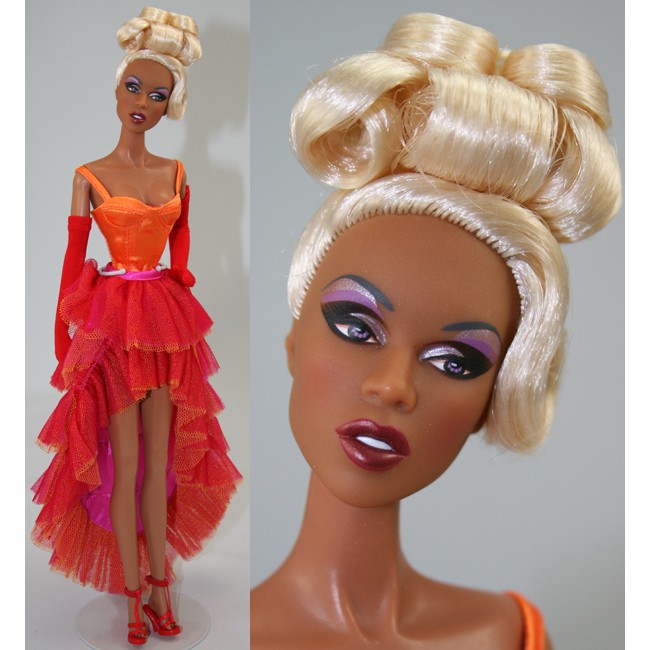
Pictured above is what the RuPaul Barbie looks like. When I read about it I was curious as to what it looked like. Without knowing it was a representation of RuPaul, would you know it was meant to be a drag queen? What does that say about all other Barbies?
Saturday, February 21, 2015
Shifting Gender Roles: Sex and The City and Girls
After watching "Boys, Girls, Boys, Girls" (Sex and The City) and "Vagina Panic" (Girls), it is evident that the idea of gender roles has been changing drastically. The episode of Sex and the City was released in 2000, where the Girls episode was released in 2012. The main difference is how much more in control of themselves the women seem. The characters in the show Girls are portrayed as independent women who have no issues making their own decisions about their lives, and love lives in particular. In Sex and The City, it is clear that these ideas of independent women are just starting to be formed. For example, the character Miranda is struggling with the idea of her boyfriend moving into her apartment. It is clear to her that she is not the stereotypical women. She doesn't like to cook, she likes to be able to lounge around and watch TV, and she doesn't like to do the laundry. When the idea of having a man in her house is brought up, she gets defensive about it, because she knows she doesn't fit into that gender role. But he boyfriend doesn't have an issue with it. This goes to show that the idea of women being the homebodies who take care of the house work is a gender role that is changing fast. All of the women in both of these episodes display some kind of personal independence. It seems as though (and I have never really watched Sex and The City), that all the women live alone, and have jobs that help them support their lifestyles. They are breaking out of the gender norm. The character Samantha is her own boss. She runs her own business. She is in charge and she doesn't take any slack from anyone. The characters in Girls mimic this kind of behavior as well. They all seem to be stable on their own, but this is more accepted than it seems in Sex and the City. It is more of a modern show, and it really depicts the way that the gender roles have progressed in 12 years.
Friday, February 20, 2015
Gendered Slang/Language: March 1st 2015
There are a lot of terms that are thrown around today that can be considered offensive to other people. We have become so accustomed to using them what we don't even realize it.
The first term that is used often is "___ has balls!", or "That was ballsy." This term is referring to when someone, male or female, does something that is daring or audacious. They are doing something impressive that normally wouldn't be done. The most common time I hear this term is when I'm driving around with my friends, especially males ones. When someone cuts them off, or runs a yellow light, etc, they'll say something along the lines of "that guys has huge balls!" Even though a male is commenting with these terms, it doesn't make that term any less sexist. This term is also misconstrued. It may seem like a compliment if it is being applied to a woman, but in reality it is just stating that 'having balls' is a must to be courageous. So a woman isn't normally audacious because she doesn't actually have balls.
Another group of terms that is used a lot are the terms "booty call" and "walk of shame". "Booty call" is understood to be when a male calls up a female late at night for sex. What makes this offensive is that it makes women seem to be objects that men can just summon when they want sex; that they are there for a man's pleasure whenever and wherever he wants. This term is also usually thought of involving men calling women, when it isn't really unlikely for a woman to call up a man. But in our society, something like this makes a woman seem "thirsty". This term is also derogatory because it makes the woman seem too eager and desperate. Finally, the term "walk of shame" is one that we hear a lot, especially on college campuses. a "walk of shame" is when a woman (or man) stays the night in someone else room or home, and walks home in their outfit from last night. It is a very judgmental term because when you see someone walking home in the party outfit from the night before, you can't help but think things like 'they must have drank too much last night', or 'I wonder whose bed they're coming from?'. Terms such as these make men and women judge what they see in a derogatory manner.
There are many other terms that are used in today society, some of which include "hook-up", "friends with benefits", or "sext". All of these terms, and more, have very gender specific meanings, and degrade a certain sex or gender based on the way they are used. Unfortunately, I think these terms are here to stay. People tend to not even realize what these phrases and terms even mean, and how they can be offensive to certain people.
The first term that is used often is "___ has balls!", or "That was ballsy." This term is referring to when someone, male or female, does something that is daring or audacious. They are doing something impressive that normally wouldn't be done. The most common time I hear this term is when I'm driving around with my friends, especially males ones. When someone cuts them off, or runs a yellow light, etc, they'll say something along the lines of "that guys has huge balls!" Even though a male is commenting with these terms, it doesn't make that term any less sexist. This term is also misconstrued. It may seem like a compliment if it is being applied to a woman, but in reality it is just stating that 'having balls' is a must to be courageous. So a woman isn't normally audacious because she doesn't actually have balls.
Another group of terms that is used a lot are the terms "booty call" and "walk of shame". "Booty call" is understood to be when a male calls up a female late at night for sex. What makes this offensive is that it makes women seem to be objects that men can just summon when they want sex; that they are there for a man's pleasure whenever and wherever he wants. This term is also usually thought of involving men calling women, when it isn't really unlikely for a woman to call up a man. But in our society, something like this makes a woman seem "thirsty". This term is also derogatory because it makes the woman seem too eager and desperate. Finally, the term "walk of shame" is one that we hear a lot, especially on college campuses. a "walk of shame" is when a woman (or man) stays the night in someone else room or home, and walks home in their outfit from last night. It is a very judgmental term because when you see someone walking home in the party outfit from the night before, you can't help but think things like 'they must have drank too much last night', or 'I wonder whose bed they're coming from?'. Terms such as these make men and women judge what they see in a derogatory manner.
There are many other terms that are used in today society, some of which include "hook-up", "friends with benefits", or "sext". All of these terms, and more, have very gender specific meanings, and degrade a certain sex or gender based on the way they are used. Unfortunately, I think these terms are here to stay. People tend to not even realize what these phrases and terms even mean, and how they can be offensive to certain people.
Subscribe to:
Posts (Atom)